Support that degrades
Foam and plastic frames compress and creep under daily load. The posture a chair delivers in year one is not the posture it delivers in year five.

Furniture should adapt to the body, not the other way around.Rubicon combines adaptive pneumatic support, sensor feedback, and a titanium structure built to last, so professionals can sit better and work longer with less strain.
Patent pending · Grade 5 titanium frame · Sensor-guided posture feedback
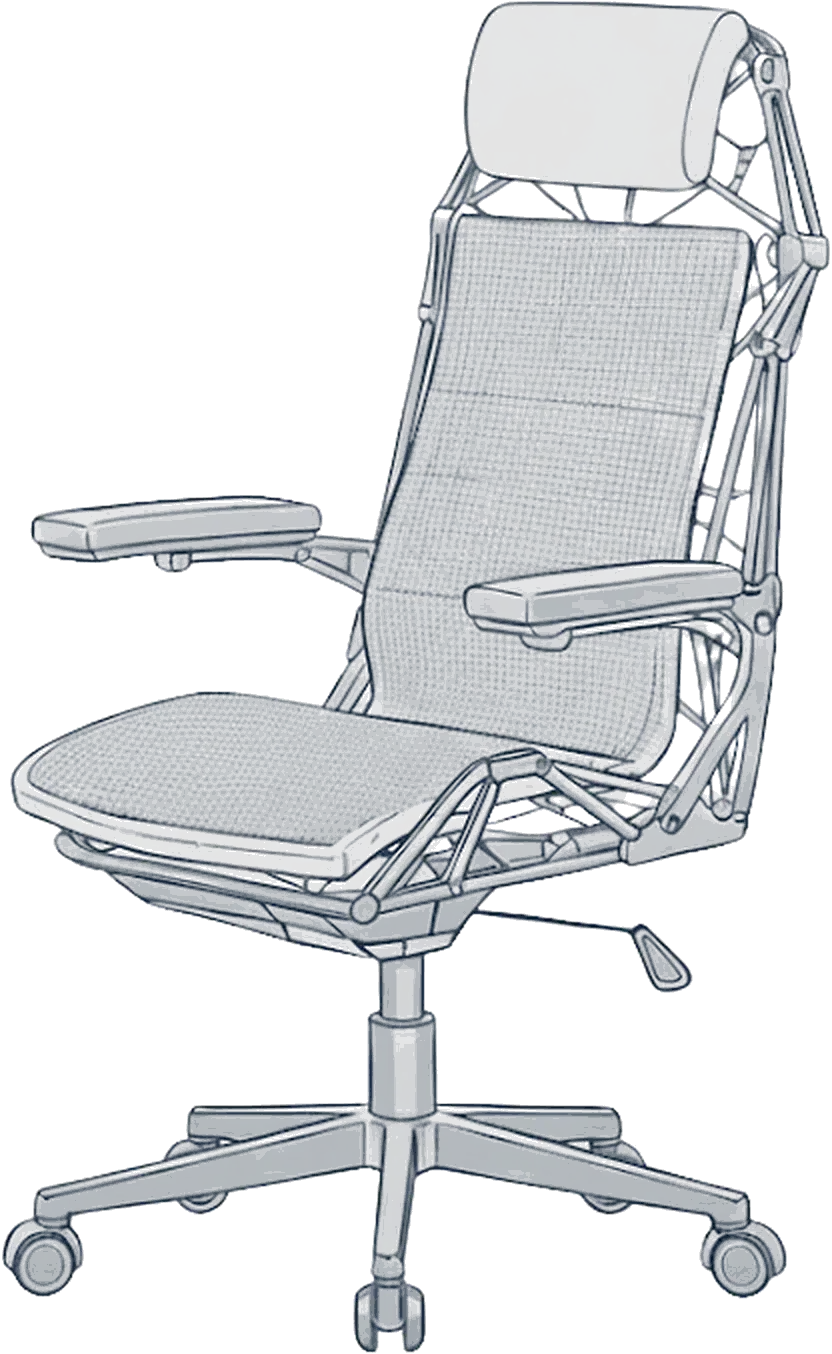
Knowledge workers spend most of the day seated, yet most office chairs offer passive support that fades over time. As the cushioning compresses, the body starts doing the chair's job.
Foam and plastic frames compress and creep under daily load. The posture a chair delivers in year one is not the posture it delivers in year five.
Static seating does not respond when you shift, slump or lean. Over long sessions that adds up to discomfort, fatigue and lost focus.
Short replacement cycles, uneven seating across a floor, and the business cost of poor ergonomics turn seating into a recurring line item instead of an asset.
In the U.S., a work injury that needs medical attention cost about $48,000 on average in 2024, counting lost wages, medical care and administrative costs. Good ergonomics is a business issue, not just a comfort one.
Traditional chairs are designed around the moment you sit down. Rubicon is designed around the eight hours that follow, and the years after that.
| Feature | Traditional office chair | Rubicon |
|---|---|---|
| Support philosophy | Passive compression | Active pneumatic support that moves with you |
| Frame material | Plastic and foam that degrade | Grade 5 titanium skeleton |
| Load path | Your spine compensates as cushioning sags | The tension-grid carries and redistributes body weight |
| Designed lifecycle | Typically replaced every 7–8 years | Engineered for 20+ years of commercial use |
| Posture feedback | — | Sensors and companion app |
| Preventive reminders | — | Shift and stand prompts before strain builds |
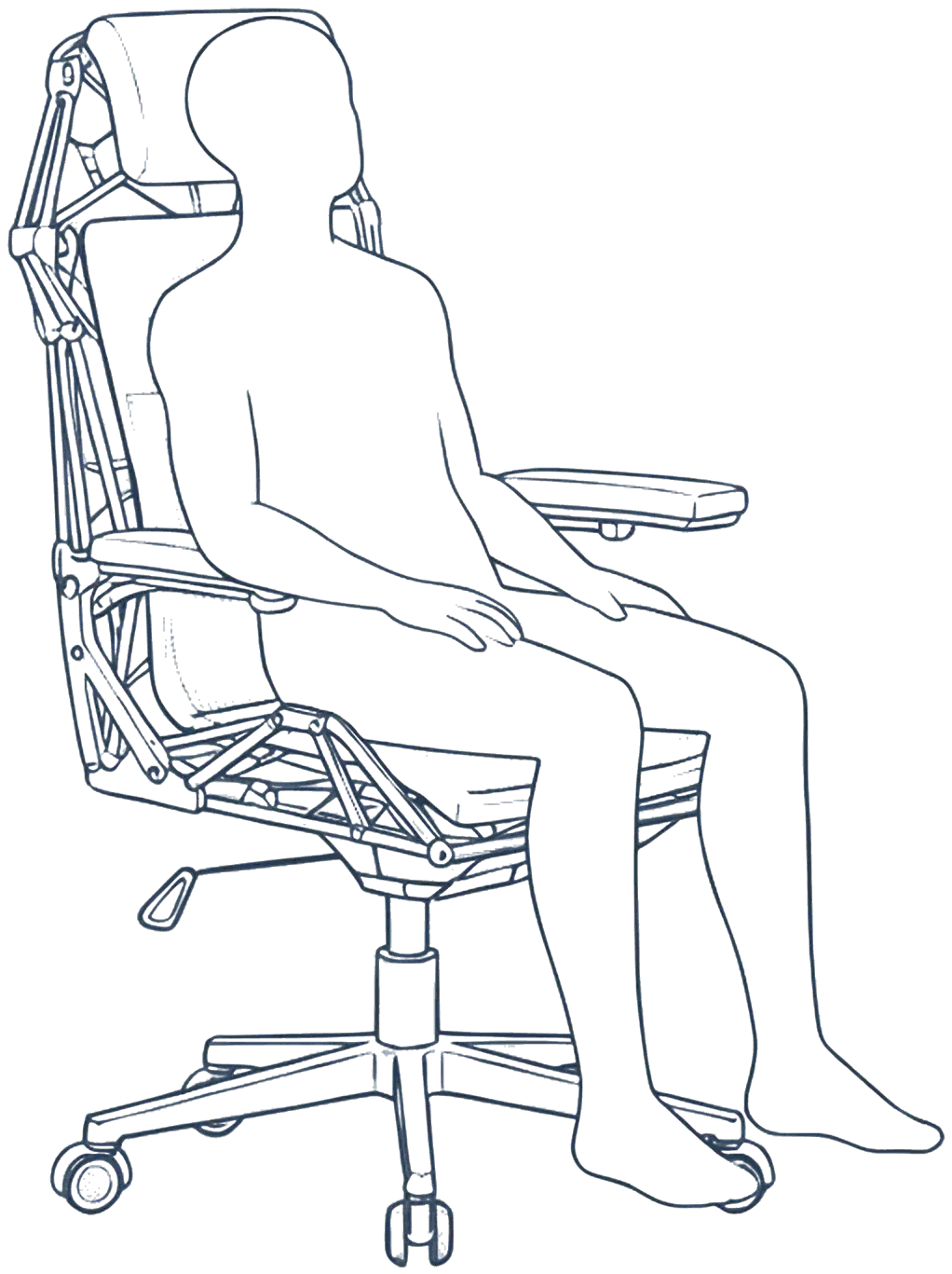
Select a point on the chair to see how each layer works. Structure, support and sensing are separate modules, so each one does a single job well.
Rubicon brings proven ideas from other industries, such as NASA-inspired zero-gravity car seats and aerospace-grade titanium, into a chair built for daily professional use.
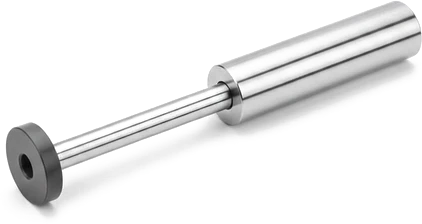
Our patent-pending system uses controlled air suspension with a non-linear response in place of static foam. It stays firm under heavier load and softens under lighter load, keeping support consistent through the day.
A Grade 5 titanium skeleton gives a light, rigid frame that resists corrosion and fatigue. An active support system needs a structure that stays true for years, and titanium is chosen for exactly that.
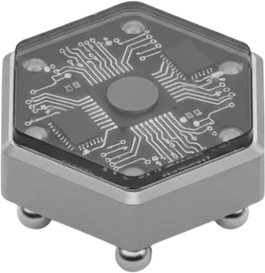
Thin-film pressure sensors in the seat track posture and pressure distribution. A lightweight embedded model spots slouching, imbalance and long stillness, then nudges you through the app.
The sensing loop runs quietly in the background. You notice the support and the occasional nudge, not the technology.
Pressure sensors map how your weight is distributed across the seat and back, using minimal power.
An on-board pattern model separates normal movement from slouching, uneven sitting and long periods of stillness.
The pneumatic tension-grid carries your load continuously, adapting as your posture changes.
The app suggests when to shift, stretch or stand, so healthier habits form before strain begins.
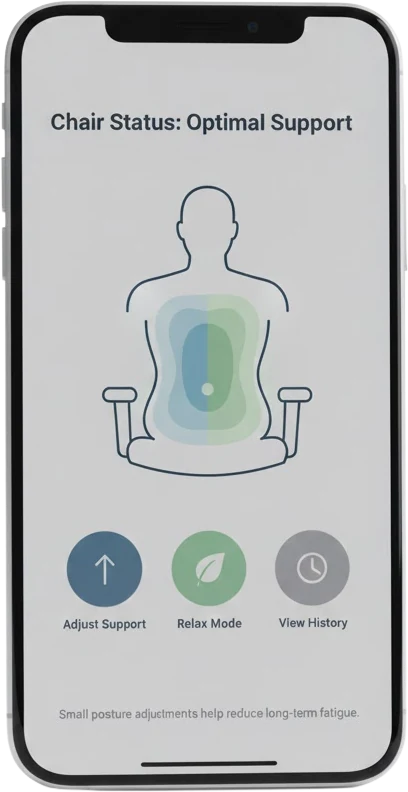
The Rubicon app turns sensor data into simple, useful guidance. It is a supporting layer: the core value of the chair is mechanical, and it works with or without the app.
See where pressure builds across the seat and back in real time.
Gentle prompts after long periods without movement, timed to your own patterns rather than a fixed timer.
Fine-tune the feel of the pneumatic support to suit your body and task.
Track sitting trends over days and weeks to see your habits improve.
Low-power by design. Passive scanning runs on standard AAA batteries with a 3–6 month target. If the batteries run out, the chair keeps delivering full mechanical support.
Rubicon is designed first for organizations where long, focused seated work is the job, and where support quality shows up in performance.
Finance, technology and professional-services firms standardizing on one long-life seat across floors and offices, with simpler facilities management.
Workstations for high-stakes professionals and environments that already hold ergonomics to a higher standard.
Developers, designers, analysts and creators who see their chair as a long-term investment in focus and comfort.
Whether it's a boutique office or a headquarters, every Rubicon deployment starts with a small pilot, proves itself, then grows with you.
Boutique offices, law firms, design studios and small practices.
Tech startups, regional firms and teams scaling into new space.
Corporate offices, institutions and multi-site organizations.
You work with us directly from first conversation to installation, so the product fits how your team actually works.
A low-risk early deployment lets your people test comfort, support consistency and day-to-day usability before any larger commitment.
We build lasting relationships around lifecycle value, with support that continues long after the chairs arrive.
As Rubicon scales, we'll partner with office furniture dealers and complementary vendors, and build presence at workplace trade shows, to reach larger customers.
Enterprise buyers judge seating by total cost of ownership, not sticker price. Rubicon turns a consumable into a capital asset: one durable chair in place of a cycle of replacements.
Illustrative only. Based on a typical 7–8 year replacement cycle for conventional office chairs (Furniture@Work) and Rubicon's 20+ year design lifecycle target. Actual service life depends on use and maintenance.
The engineering targets behind the Rubicon design.
Specifications are design targets and may change as development continues. Rubicon is designed for workplace wellness and is not a medical device.
With the concept, business plan and patent filing complete, our next step is a working prototype. We scale only after real users have tested it.
Product concept and business plan complete, and a Canadian patent application filed in January 2026.
Build a working prototype of the pneumatic support system and test durability and comfort.
Early deployments with partner teams, gathering feedback on comfort, consistency and usability, then sharing the results.
Channel partnerships with furniture distributors, workplace trade shows, and expansion into sectors where long seated work matters most.
Have another question? Email info@rubiconseating.com.
We're inviting a small group of individuals and teams to test early Rubicon prototypes and tell us what works and what doesn't. Your feedback will shape the final chair.
info@rubiconseating.comThanks for signing up. We'll be in touch when early testing opens.